Where to Start the Appian Way
The road begins at Porta San Sebastiano and that is the worst place to start it. The four realistic access points, how to reach each, and which suits your day.
This is the most-asked question about the Appian Way and the worst-answered. Ask where to start and most pages tell you where the road begins, which is a different thing and a genuinely bad plan.
The Appian Way begins at Porta San Sebastiano in the Aurelian Walls. Do not start there.
Why the official beginning is the wrong beginning
The first stretch outside the gate is the least pleasant part of the entire route. It is narrow, hemmed in by walls, carries real traffic, and has essentially no shade. There are few monuments and nothing to look at except the cars behind you. It goes on long enough to matter.
Guided tours ride or transfer past it, every single one of them. That is not an accident of routing — it is the industry quietly agreeing that this section is not what anyone came for.
For the record, since it is the other half of the question people ask: the road runs from Porta San Sebastiano to Brindisi, on the Adriatic coast, about 540 kilometres away. The UNESCO inscription granted in 2024 covers that entire historic route, including the later Via Traiana branch that Trajan built from Benevento. None of that is what you cycle in an afternoon. The Appian Way you visit is the first 16 kilometres, which is the section protected inside the Parco Regionale dell’Appia Antica along with the Caffarella valley, the Tombs of Via Latina and the aqueduct park.
The four realistic starting points
1. Let the tour start it for you. The default and, for most visitors, correct answer. Guided rides meet in the centre and handle the link out, some with hotel pickup or a private transfer included. If you are staying north of the river or near Termini, that transfer is worth real money — it is the difference between an hour of your day spent in Roman traffic and an hour spent on the road you booked for.
2. The park’s information point, near the start of the good section. If you are riding independently, this is where you want to actually begin: past the walled stretch, where the paving, the tombs and the umbrella pines start. Buses run out along the corridor from the centre, and it is the standard drop-off for people who want to walk or ride from the interesting end.
3. The aqueduct park side. The neatest independent option and the one almost nobody uses. Rome’s Metro A serves Giulio Agricola and Subaugusta, and the Parco degli Acquedotti is a short walk from either. Start at the arches, ride down through the Caffarella valley, and join the Appian Way from the side. This reverses the traffic problem completely — you arrive at the road already in the good part — and it means the aqueducts happen at the start of your day rather than as an exhausted afterthought.
4. Cecilia Metella, if you only want the famous bit. If your plan is a short walk rather than a ride, the cluster around the Tomb of Cecilia Metella and the Circus of Maxentius is the corridor’s densest stretch of monuments and its most photographed paving. It works as a two-hour visit rather than a day.
Which one suits your day
| Your situation | Start here |
|---|---|
| First visit, want the whole corridor | On a guided tour from the centre |
| Independent, want the aqueducts too | Metro A to Giulio Agricola, ride down |
| Independent, want the road itself | Bus out to the park’s information point |
| Short on time, want the photograph | Cecilia Metella and the Circus of Maxentius |
| Staying far from the corridor | A tour with transfer or hotel pickup included |
Go at the weekend if you can
Rome operates a limited-traffic zone over the central section of Via Appia Antica — between Via delle Mura Latine and Via Appia Pignatelli — plus part of Via Ardeatina, on Saturdays and Sundays from 07:00 to 19:00, all year except August, with a 30 km/h limit inside it. Electronic gates were switched on from 19 September 2026 after a supervised test period.
That makes the weekend the quiet time here, which is the opposite of the rule everywhere else in Rome. On the narrow stretches, where a car passing is genuinely unpleasant on a bike, it is the difference that matters most.
One thing to sort before you set off
Whichever end you start from, check which catacomb is open on your day before you plan the route around one. The three big catacombs on the corridor close on three different weekdays — San Sebastiano on Monday, Domitilla on Tuesday, San Callisto on Wednesday — and all three are guided-visit only, so you cannot simply arrive and walk in. The full detail, with hours, is on the catacombs page.
If you are riding independently and want to include one, the honest advice is to plan the catacomb first and the ride around it. If you are on a guided tour, read the inclusion line: it names the catacomb, and that name plus the day of the week tells you whether the underground half of your tour is actually going to happen.
What about walking it?
You can walk a section very happily. The paved stretch inside the park is quiet, level and lined with tombs, and two or three kilometres of it is a genuinely good morning for anyone who would rather not be on a bike.
What you cannot do is cover the corridor on foot. The road, the Caffarella valley and the aqueduct park are strung across 16 kilometres, and seeing the sequence is the whole point. That is the reason the tour listings are dominated by bikes and carts rather than walking tours — not fashion, just distance. If walking is your preference, plan one section plus one catacomb and let the rest go.
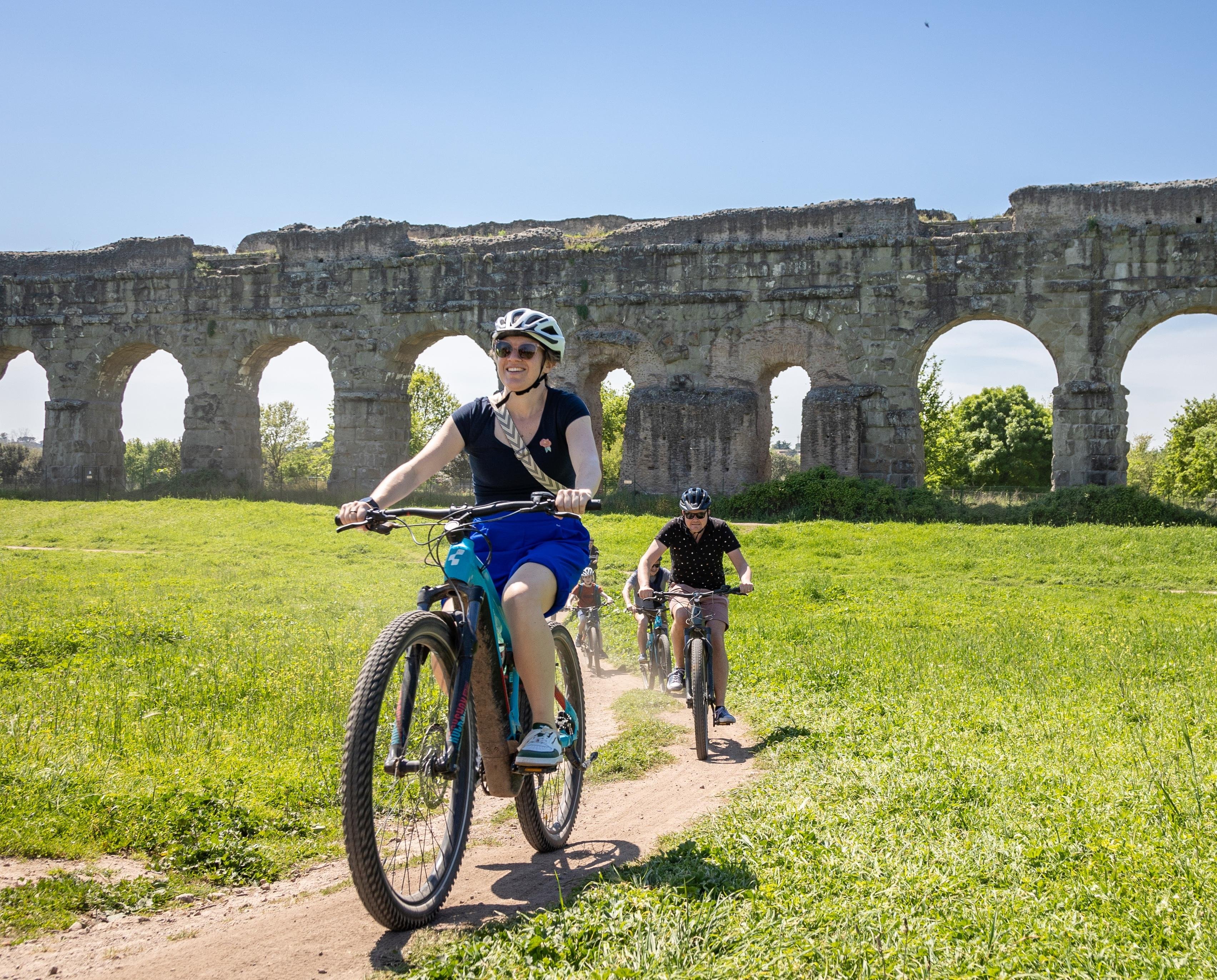
Let the Tour Handle the Getting There
Nearly every guided ride meets in central Rome and transfers or rides out past the worst stretch. The corridor's best-reviewed tour runs full-suspension e-bikes over the road, the Caffarella valley and the aqueduct park, rated 4.9/5 by 1,781 verified guests, from about $87.
Check Availability & Book