Why the Appian Way Is Famous
A road begun in 312 BC, six thousand crucifixions in 71 BC, and a UNESCO World Heritage listing in 2024. What actually makes the Regina Viarum matter.
The Appian Way is famous for three separate reasons that most pages blur into one. They are worth separating, because only one of them is what you actually see when you go.
It was the first proper road, and it was built to win a war
Construction began in 312 BC, under the censor Appius Claudius Caecus, whose name it still carries. Rome was fighting the Samnites, and the road existed to move an army south faster than an army could be moved before.
What made it different from what came before was engineering rather than route. It was surveyed straight, drained, cambered, and surfaced to last — and the surface you ride over today, large polygonal basalt blocks fitted together, is the same idea. Later Romans called it Regina Viarum, the queen of roads, and the phrase stuck for two thousand years.
Eventually it ran all the way to Brindisi on the Adriatic, roughly 540 kilometres, which made it the land route towards Greece and the eastern Mediterranean. That is the reason it mattered for centuries after the Samnite war was forgotten: it was the road to everywhere that Rome wanted to trade with.
Six thousand crucifixions
The followers of Spartacus were crucified along this road in 71 BC.
This is the single most-searched fact about the Appian Way, and the plain version is grim enough without embellishment. After the slave revolt was defeated, Crassus had the surviving rebels crucified along the road running from Rome towards Capua — ancient sources put the figure at around six thousand, spaced out along the route so that anyone travelling into the city passed them.
Two things are worth saying about it honestly. The first is that the road was already two and a half centuries old when it happened; the crucifixions are an episode in its history, not its origin. The second is that there is nothing to see. No monument marks it, no stretch is identified with it, and any guide who points at a specific spot is inventing. What the fact does is change how the road feels underfoot, which is a real thing to get from a place, but it is not a sight.
The tombs are there because of a law
Ride the corridor and the dominant impression is funerary — mausoleums, brick cores, inscriptions, the great drum of Cecilia Metella. That is not Roman morbidity. It is zoning.
Roman law forbade burial inside the city walls. The wealthy therefore built their tombs along the main roads out, where the maximum number of travellers would read the family name. The Appian Way was the most important of those roads, so it got the most ambitious tombs. Everything about the way the corridor looks follows from that one rule.
The Tomb of Cecilia Metella, built in the first century BC for the daughter and wife of powerful families, is the landmark most people use as a turning point — later fortified into a castle by the Caetani, which is why it looks like a keep. Next to it, the Circus of Maxentius is the best-preserved Roman circus anywhere, complete enough that you can read its starting gates and central spina, and it is almost always empty.
The catacombs came later and for a different reason: the same ban on burial inside the walls, applied to Christian communities who dug down rather than out. They are visitable only on a guided walk, and the three main ones close on three different weekdays — detail here.
UNESCO agreed, in 2024
In 2024 the World Heritage Committee, meeting in New Delhi for its 46th session, inscribed Via Appia. Regina Viarum on the World Heritage List. It was Italy’s 60th listing, keeping the country top of that particular table, and the first candidacy promoted directly by the Italian culture ministry.
The citation is about engineering rather than beauty: the exceptional universal value of a work that stayed essential to commercial, social and cultural exchange with the Mediterranean and the East across centuries. The inscription covers the whole historic route from Rome to Brindisi, including the later Via Traiana branch that Trajan built from Benevento — not just the 16 kilometres you can cycle.
That is worth knowing before you go, because it explains a mismatch you will otherwise notice: the road is described in language that sounds enormous, and the thing you visit is a quiet green corridor on the edge of a suburb.
So is it worth going?
If you have three days or more in Rome, yes, and it is the best half-day the city has outside the walls. If you have 48 hours and have not seen the Forum, no. That is the honest split.
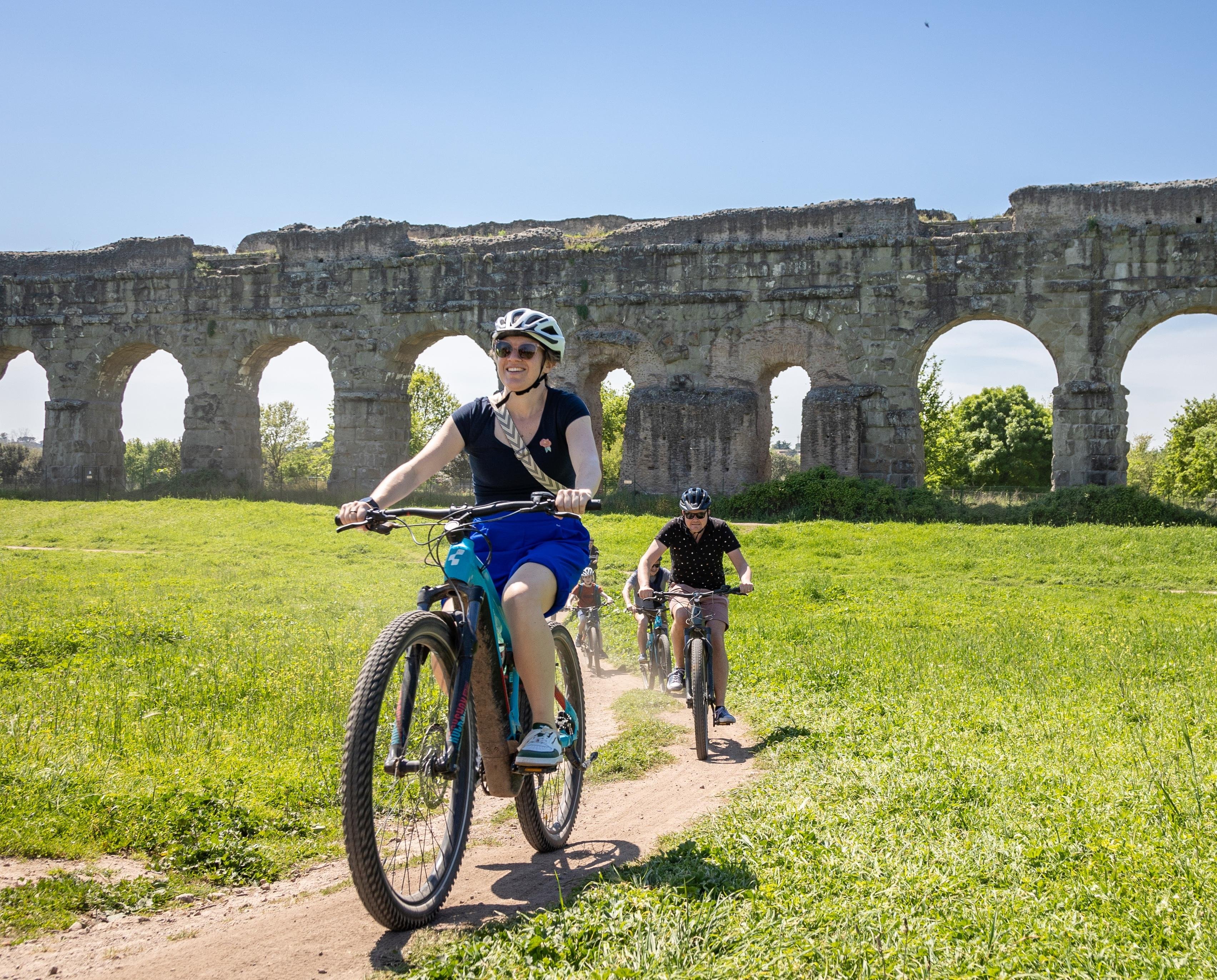
What the Appian Way is good at is not what Roman monuments are usually good at. There is no single view that pays for the trip. It is cumulative: pines, tombs, sheep grazing in the Caffarella valley, an aqueduct arcade striding across an open field, and long stretches where you can hear birds instead of scooters.
It also has one quality no other piece of ancient Rome has. The crowd disperses. The monuments are strung along 16 kilometres, so instead of queueing for a timed entry you are simply on a road, mostly alone. For anyone who has spent two days in Roman queues, that is worth more than another ruin.
The best way to feel all of that is to move through it slowly, which is why the corridor sells rides rather than visits — every guided bike tour out here is an e-bike tour, because the basalt decided that a long time ago.
See the Road Itself
The corridor's best-reviewed ride covers the paving, the tombs, the Caffarella valley and the Parco degli Acquedotti on a full-suspension e-bike, with a catacomb entry on the option. Rated 4.9/5 by 1,781 verified guests, from about $87.
Check Availability & Book